The Fire Retardant in Your Fish
On January 8, 1966, a South African ship caught fire at sea. When it was in port in Bristol, England, firefighters pried open the smoking container, and the conflagration spread and burned for five days.1 A little over a month later, on February 11, a Liberian steamship caught fire near Rotterdam. The blaze spread and ignited a storage area with barrels of petrol, raging for several days, before melting the deck and mast and eventually sinking the vessel.2 Then, on March 19, 1966, a Danish ship caught fire off Long Beach, California, injuring three firefighters and killing a longshoreman, and causing over a million dollars in estimated damages.3
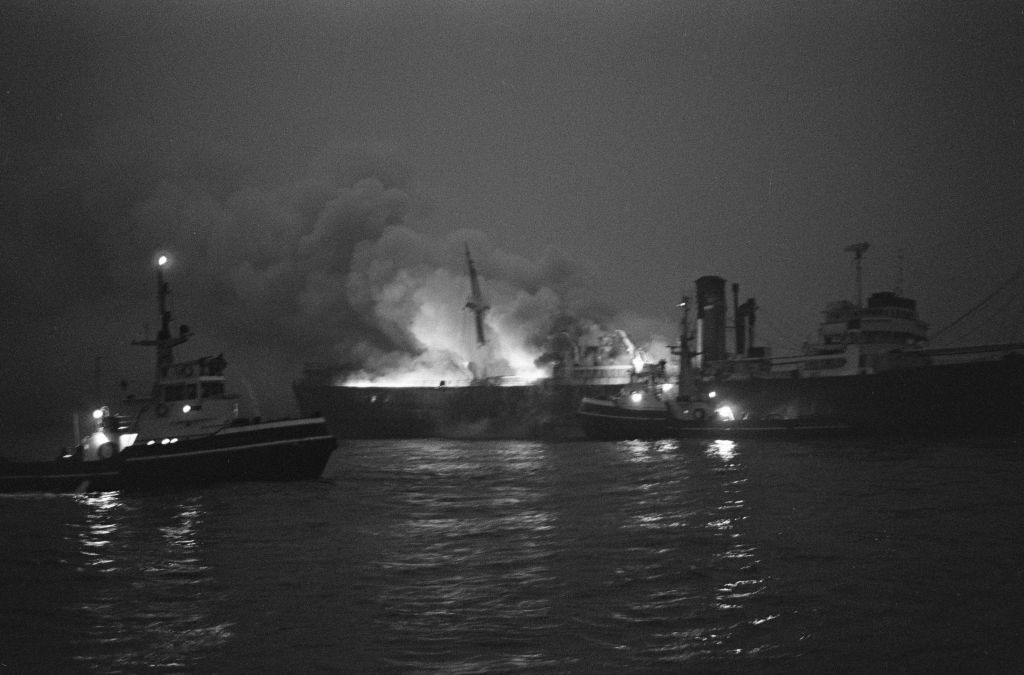
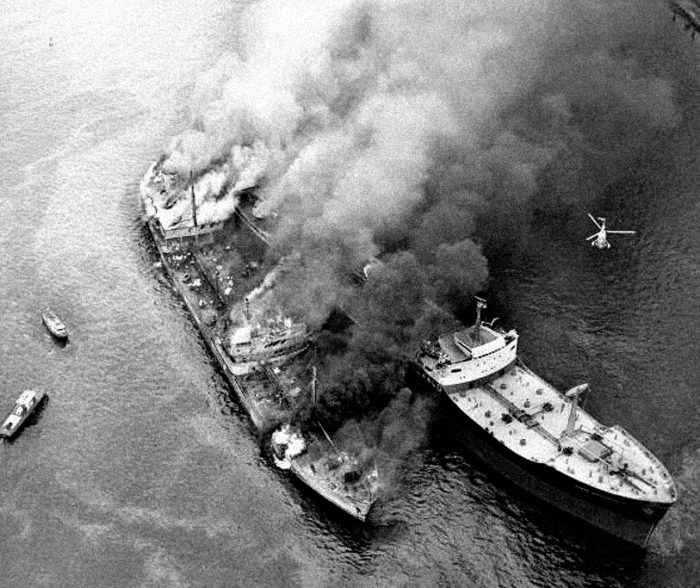
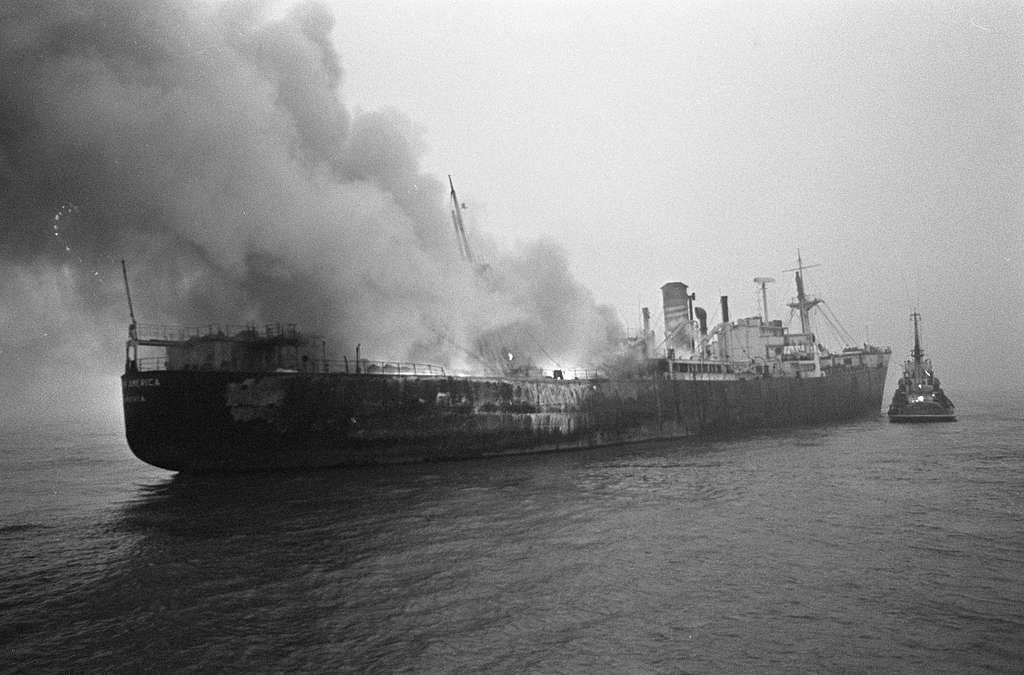
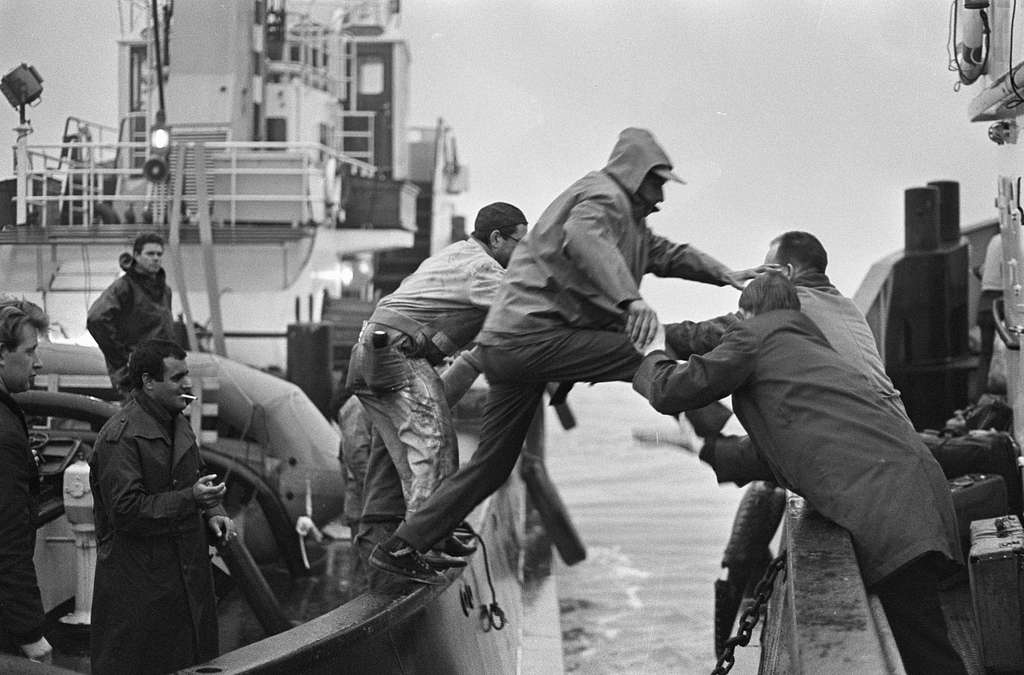
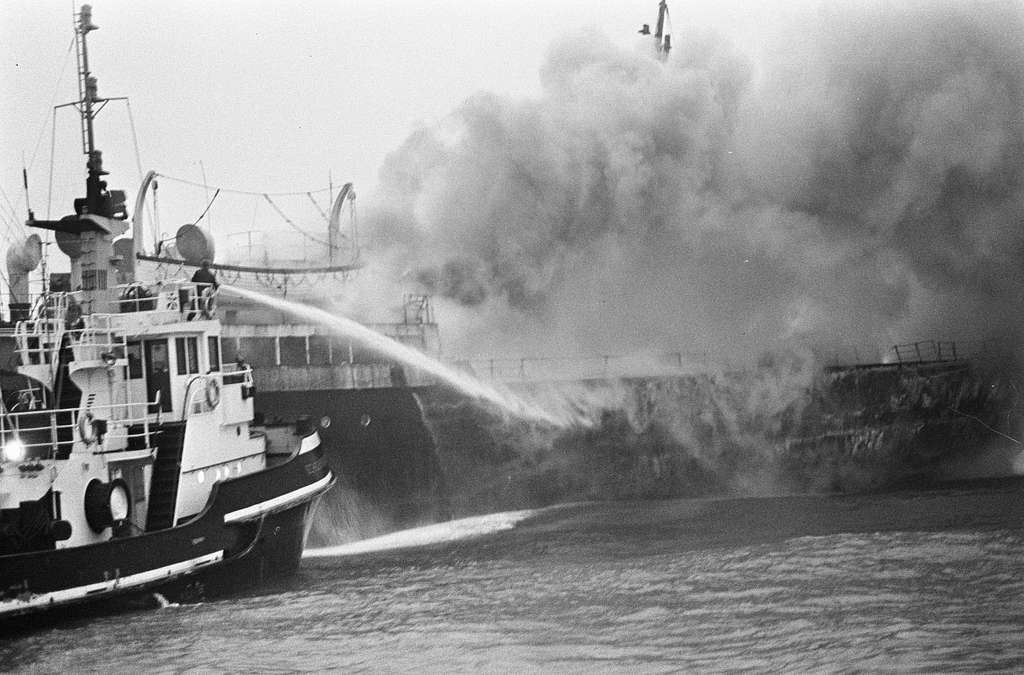
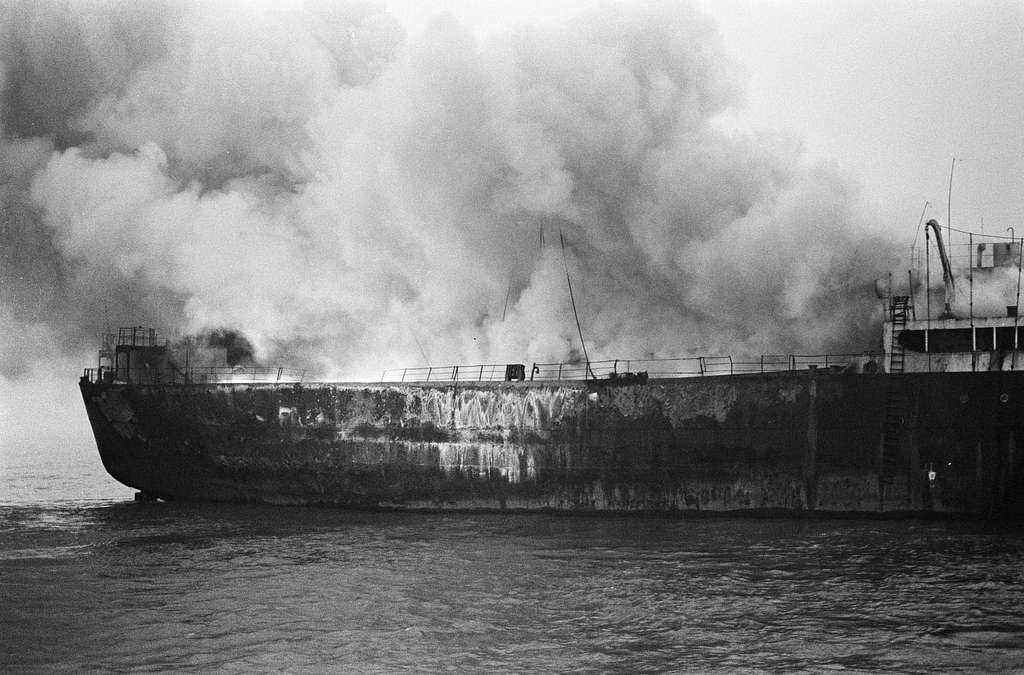
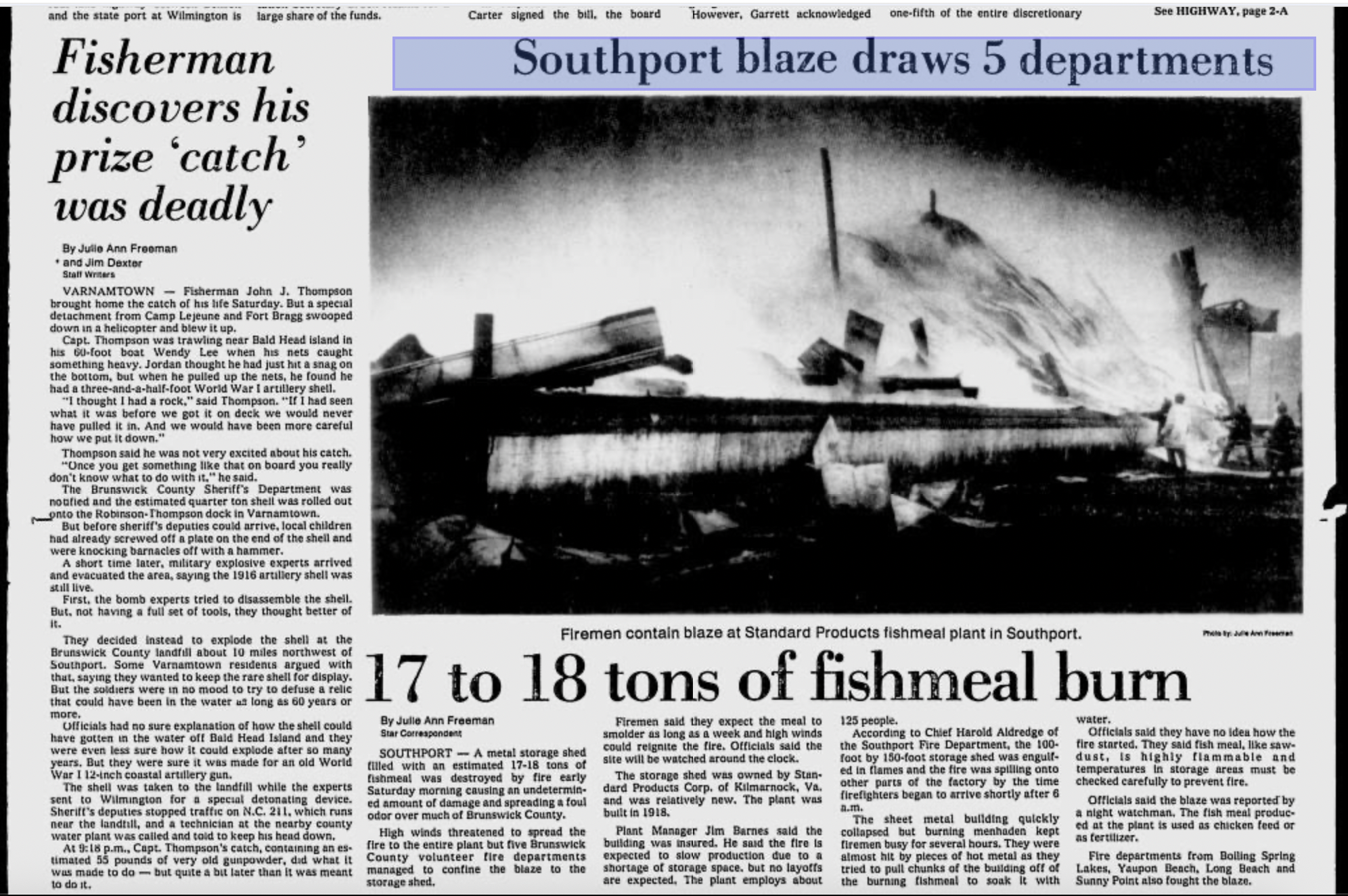
The culprit in each fire was fishmeal, a highly flammable cargo. This dark-yellow powder—made by drying and pulverizing fish for use as animal feed in chicken, pig, and especially aquaculture farms—is known for spontaneously combusting as it decays and oxidizes. From the 1950s through the 1970s, fishmeal cargo ignited at least 90 fires on ships and in plants around the world, according to a sweep of historical news coverage by The Outlaw Ocean Project.4M
For seafarers, insurers, dock workers, and port firefighters throughout the 1950s and 1960s, fishmeal’s combustibility was a serious worry. One feed manufacturer called it “practically as flammable as gunpowder,” causing fires that are “notoriously hard to control” and that can burn for multiple days, even in a flooded ship’s hold, according to a 1962 article in a Californian newspaper, the Independent.5 The chairman of the Liverpool Underwriters’ Association, an insurance group, cited fishmeal as a primary reason the 1960s were the “worst in living history” for ship losses in their 1963 annual report of casualty statistics.6M
Fishmeal fires
87 fires in fishmeal cargoes, plants, and warehouses, 1950–1978
ShipPlantStorageUnknownEvery dot is one fire
- Plant USA (OR)
Del Mar Canning Company
A fire broke out in the Del Mar Canning Company’s fishmeal plant, causing $250,000 in losses and injuring three people. Source
- Ship Netherlands
Anastasia
Firefighters battled a blaze in the cargo of fishmeal and beans aboard the Panamanian ship Anastasia Source
- Ship Netherlands
Harpon
A cargo of fishmeal caught fire on the Argentine tanker Harpon while at harbor. Onlookers noticed that the “hull of the ship was glowing.” Source
- Plant Netherlands
J. Verheggen farm
A fire raged in a shipment of meat and fishmeal stored at a barn. The meat and fishmeal, imported from South America, was destined for cattle feed. Damage was estimated at 3 tons. Source
- Ship USA (CA)
Luise Bornhofen
A fire broke out among 400 tons of sacked fishmeal on the German freighter Luise Bornhofen, as firemen tried for 22 hours to put out the flames. Source
- Plant USA (VA)
McNeal Company
A fire likely caused by spontaneous combustion swept through the fish processing plant of McNeal Company Inc. in Virginia, causing $750,000 in damage. Source
- Ship USA (CA)
Tritone
Fire broke out in a cargo of fishmeal on the Italian freighter Tritone. The fire caused “the paint to sear off” and “the hull was so hot it sizzled along the waterline.” Source
- Plant USA (NY)
Dold Feed
After a fishmeal plant owned by Dold Feed Co. was destroyed by fire, “300 tons of soggy fish meal” emanated foul odors as far as ten miles inland. Source
- Plant USA (NC)
Menhaden
The Menhaden Fish Factory at Melt Lee Island, which makes fishmeal and oil, was almost completely destroyed by fire. Source
- Plant Netherlands
De Toekomst
A fire raged among several hundred bags of fishmeal stored at the De Toekomst fishmeal factory. As firefighters extinguished the flames, the water-soaked fishmeal “spread a foul smell.” Source
- Ship Italy
V.N.S. Ouwerkerk
A cargo of fishmeal broke out in flames on the V.N.S. Ouwerkerk at the port of Naples, en route to the Netherlands. Source
- Ship Netherlands
Leuvekerk
Fishmeal caught fire on the Dutch ship Leuvekerk, sailing from Dakar to Genoa. An investigation by the Shipping Council found that, due to stormy weather in the Indian Ocean, the ship’s hatches had to be closed and the fishmeal was unable to be ventilated. Source
- Ship Netherlands
M.S. Messina
Fire was raging in the fishmeal cargo of the German M.S. Messina, which had arrived in Rotterdam from West Africa. Source
- Ship Ecuador
Ciudad de Quito
A fire broke out on the ship Ciudad de Quito carrying fishmeal from Peru to New Orleans. An officer said the heat in the hold may have ignited the fishmeal cargo. Some “suffered early asphyxiation” and were hospitalized. Source
- Ship Netherlands
Barenstein
The German freighter Barenstein became the seventh ship in recent weeks to arrive in Rotterdam from South America with its fishmeal cargo on fire. The fire started at sea and burned for six days. Firefighters flooded the holds with 300,000 liters of water. “The Rotterdam brigade now knows what fire in a cargo of fishmeal means,” reported the Dutch newspaper De Gooi-en Eemlander. Source
- Ship Netherlands
Axelfels
Starting at 2:30 in the morning, Rotterdam firefighters pumped water into the hold of the German freighter Axelfels, whose smoldering fishmeal cargo “spread a suffocating smoke.” Source
- Ship USA (MS)
Ship Island
The vessel Ship Island, owned by the Fish Meal Co. of Pascagoula, became engulfed in flames. Several aboard jumped into the water to avoid the flames. Source
- Plant Netherlands
Fishmeal factory in Beverwijk
A “sea of flames” burned at a fishmeal factory in Beverwijk, destroying the factory and a thousand tons of fishmeal. “Suffocating columns of smoke and the penetrating stench of fishmeal hampered the progress” of firefighters, newspapers reported. Barrels of acetylene and oxygen at the factory’s lab exploded. Damage was estimated at 1.5 million guilders ($830,000). Source
- Storage Netherlands
N.V. Bon-Da’s Cattle Feed Factory
A storage of fishmeal ignited at a warehouse owned by N.V. Bon-Da’s Cattle Feed Factory. The fire was caught by residents who spotted smoke in the middle of the night. Source
- Ship Netherlands
M.S. Winipah
Fire broke out in the holds of the M.S. Winipah at the quay near Rotterdam, with the likely cause being the vessel’s cargo of fishmeal. Source
- Ship Netherlands
S.S. Atlantic Guardian
The Panamanian S.S. Atlantic Guardian entered into port carrying over five tons of smouldering fishmeal from Peru. “Flames were shooting out of the cargo” as firefighters tried to control the flames. Source
- Ship Netherlands
Portalon cargo
A brigade spent hours battling a fire in a cargo of fishmeal aboard the Liberian cargo ship Portalon, hailing from Peru to Europe. Fire had broken out once already on the ship and extinguished in Spain, before igniting again during unloading in Rotterdam. Source
- Ship USA (HI)
Marua
The Norwegian freighter Marua moored with a burning cargo of fishmeal in its hold. Source
- Storage USA (ME)
Maine Sea Products
13,000 tons of bagged fishmeal owned by Maine Sea Products Inc. went up in flames at a warehouse. The blaze lasted for three days. Source
- Ship Netherlands
White Star
Four-meter flames shot up from the holds of the Liberian ship White Star, whose fishmeal cargo from Peru ignited en route to Rotterdam. The fire lasted several days. Source
- Ship Netherlands
Wiesbaden
The Rotterdam fire brigade tried for hours to put out a fire in a cargo of fishmeal aboard the German ship Wiesbaden. Source
- Storage Puerto Rico
Dock #5 at the San Juan Pier
Sacks of fishmeal unloaded from a ship burst into flames, destroying the pier and causing damages of $1 million. The fire was discovered at 1am. Tourists coming home from restaurants and nightclubs said it was “the first time they had seen a fire of such magnitude.” For weeks, the pier emitted “stench of rotting fish” before it was later dismantled. Source
- Ship Bermuda
Cape York
Fire broke out in the fishmeal cargo carried by the British freighter Cape York from Peru to Liverpool, threatening to capsize the ship. Source
- Ship Netherlands
Portalon
“Rarely has a cargo of fishmeal in the port of Rotterdam burned as fiercely,” reporters wrote about a midnight blaze aboard the Liberian ship Portalon. When workers opened the hatch to unload the 1,800 tonnes of fishmeal cargo, flames several meters high “suddenly burst” from the hold. Firefighters flooded the hold with tens of thousands of liters of water. Source
- Ship UK
Madeleine
1,000 tons of fishmeal went up in flames aboard the Swedish ship Madeleine. The vessel, coming from Peru, had been sailing in the Atlantic for five days with the blaze in its hold. The ship was 700 miles from the nearest port and its radio was broken, so it routed to Penryn, UK. It was headed to Rotterdam. Source
- Ship UK
M.S. Brandaris
A fire broke out in the Dutch M.S. Brandaris, carrying a cargo of fishmeal, in the port of Manchester. Source
- UK
Firemen were called to put out 750 tons of fishmeal burning on a ship at Surrey Docks. Source
- Ship Spain
North Viscountes
Fishmeal caught fire at sea aboard the Greek vessel North Viscountes, which was traveling to Spain from Peru. Source
- Plant Canada
B.C. Packers
Fire broke out at a warehouse next to a fish processing plant, where “columns of smoke from tons of smouldering fish meal” were “swirling high above the blackened ruins.” Source
- Ship Puerto Rico
Machalakis
The vessel Machalakis sent out distress calls after a fire started in one of its fishmeal holds 40 miles out from the coast, causing the ship to tilt in the water. Source
- Ship Netherlands
Tobon
A fire blazed for four days in the fishmeal cargo of the Norwegian freighter Tobon. To limit the damage, firefighters at the port of Rotterdam flooded the vessel’s hold. Several hundred tons of fishmeal were destroyed. Source
- Ship USA (CA)
Santa Malta
At a Los Angeles harbor, four fire companies tried to fight a blaze that broke out among bagged fishmeal on the freighter Santa Malta when it was sailing to San Francisco from Mexico. Source
- Ship Netherlands
MS Patmos
Fire broke out in two holds of fishmeal on the Greek vessel MS Patmos, likely while it was en route from Peru to Rotterdam. “Fishmeal, which is a regular cause of ship fires, smolders very stubbornly,” reporters wrote. “Often the holds have to be flooded to avert the danger once and for all.” Firefighters worked overnight to control the flames. Source
- Ship Netherlands
Santa Elena
Three fire engines fought a blaze on the German ship Santa Elena at the port of Amsterdam. The vessel, which operates services to South America, was carrying 250 tons of fishmeal. As soon as the cargo came into contact with the air, the flames broke out. Source
- Ship Netherlands
Theomana
Firefighters in gas masks flooded the hold of Panamanian vessel Theomana, where burning fishmeal was emitting “greasy clouds of smoke” and “a penetrating stench.” The vessel was carrying 5,700 tonnes of fishmeal from Peru. Source
- Ship Netherlands
Ivan Bacon
The English freighter Ivan Bacon, carrying a burning cargo of fishmeal, was turned away from the Vlissingen port. Source
- Ship UK
Kenuta
A cargo of fishmeal went up in flames aboard the freighter Kenuta during its voyage from South America. About 100 bags of fishmeal were tossed overboard. Source
- Plant Netherlands
N.V. Gekro
Smouldering fishmeal burst into flames in an exhaust duct at the company of N.V. Gekro in Rotterdam. Source
- Ship UK
Pizarro
Fire broke out among bags of fishmeal aboard the British ship Pizarro, which was coming to unload at a port in England from the west coast of South America. Source
- Storage Netherlands
Shed #3 at Spoorweghaven Port
Sparks from welding work ignited a storage shed of two hundred tons of fishmeal. Source
- Ship USA (PA)
Sygna
Fire broke out among 4,348 bags of fishmeal and anchovy fertilizer aboard the Norwegian freighter Sygna. The unloading of the shipment, coming from Chimbote, Peru, had been delayed due to a longshoremen’s strike. Source
- Ship UK
S.S. Flamenco
More than 60 firemen “battled in choking smoke” for seven hours to put out a fire deep in a hold of 800 tons of fishmeal aboard the S.S. Flamenco, sailing in from Valparaiso, Chile. Source
- Ship USA (HI)
Ioanna
A cargo of fishmeal broke out in flames on the Greek freighter Ioanna en route from Peru to Japan. The skipper radioed the Coast Guard, saying that “temperatures were rising and smoke emerging from his number four hold.” Source
- Ship Netherlands
Travestein
A fire broke out in a cargo of fishmeal on the German ship Travestein, causing an estimated damage of 10,000 guilders ($5,500 dollars). Source
- Ship UK
Santander
The freighter Santander docked at Liverpool with its cargo of fishmeal on fire and its bows damaged. Firemen believed the fishmeal had overheated in the mid-Atlantic. Source
- Ship Portugal
Potosi
Fire broke out among the fishmeal cargo of the British vessel Potosi near Lisbon, headed to the UK from the west coast of South America. The smoke had made the crew’s quarters “untenable.” Source
- Ship Spain
Atlantic
A fire started aboard the Greek ship Atlantic, where there was a cargo of fishmeal. Source
- Ship USA (MS)
Santa Maria
Firemen fought a blaze aboard the Peruvian freighter Santa Maria, which arrived carrying 1,300 tons of fishmeal. “Dense columns of black smoke poured out” as firefighters battled the conflagration. Source
- Ship Netherlands
Perene
Firefighters battled a fire burning overnight in 1,300 tons of fishmeal aboard the Peruvian ship Perene, moored in Rotterdam. Source
- Ship UK
Aren
he Dutch ship Aren with a burning cargo of fishmeal moved into Plymouth Sound in order for firemen to control the blaze. Source
- Ship UK
Styliano Restis
Fire broke out in the fishmeal cargo of the Greek ship Styliano Restis, which had to use an emergency anchor to pull into Falmouth Bay. Source
- Ship UK
Hornbelt ship
A fire broke out on the German cargo vessel Hornbelt, destroying 600 tons of fishmeal. Source
- Ship UK
Eden freighter
The Royal Mail Lines freighter Eden radioed as she approached Liverpool that the ship’s cargo of fishmeal was overheated. Firefighters put out a fire in one of the ship’s holds.
- Ship UK
S.S. Kenuta
The Liverpool Fire Brigade rushed to the S.S. Kenuta to put out a fire that broke out among its bagged fishmeal. Source
- Ship UK
Cototaxi freighter
Liverpool firemen stood by as dockers unloaded a smouldering cargo of 200 tons of fishmeal from the freighter Cototaxi. Source
- Ship Portugal
Salaverry ship
On Christmas Eve, the captain of UK vessel Salaverry radioed that fire had broken out in the ship’s fishmeal cargo. The fire blazed for two days. A news agency messenger from Lisbon described the fire as “very violent.” Source
- Ship USA (GA)
Perene freighter
The Peruvian freighter Perene pulled into a dock in Savanna after unsuccessful attempts to put out a fire that broke out in its fishmeal cargo at sea. Source
- Ship Peru
S.S. Maranon ship
In April and May 1965, the S.S. Maranon picked up about 132,000 sacks of anchovy fishmeal from Peru and headed to Maryland. A few days after leaving port in Chancay, fire broke out in the cargo. Source
- Ship Colombia
Aris ship
A fire broke out onboard the Greek vessel Aris. The vessel had arrived at the docks to unload 200 tons of fishmeal imported from Peru by Purina Colombia S.A. Source
- Ship Netherlands
Liberian M.S. Sokorri ship
For five hours, firefighters battled a blaze in the fishmeal cargo aboard the Liberian M.S. Sokorri, moored in Rotterdam. Source
- Ship UK
Kolbjorg ship
A fire broke out in the hold of the Norwegian vessel Kolbjorg, loaded with fishmeal, at a dock in London. Source
- Plant Netherlands
De Toekomst
At 5am on Sunday morning, a passerby saw smoke coming from the storage shed of the De Toekomst fishmeal factory. A fire brigade managed to control the “raging fire.” Source
- Ship Netherlands
Atki freighter
Dutch firefighters poured water into the Greek freighter Atki, trying to reach the flames that broke out in its cargo of corn and fishmeal bound from Ethiopia to the Netherlands. The crew abandoned the ship and the vessel capsized. There were no injuries. Source
- Ship UK
Stirlingshire freighter
Fire crews stood by at a dock overnight as the fishmeal cargo of the freighter Stirlingshire smouldered. Source
- Ship UK
Statesman ship
Smoke billowed from the hold of the South African Statesman vessel, where fire had broken out due to spontaneous combustion of the fishmeal cargo. Dockers unloaded smouldering cargo as firefighters poured thousands of gallons of water onto the ship to fight the blaze, which went on for five days. Source
- Ship USA (CA)
Oriana freighter
Six Los Angeles fire companies battled a fire that broke out in a cargo of fishmeal aboard the Panamanian freighter Oriana. Source
- Ship Netherlands
South America ship
The Liberian steamship South America was “blazing from bow to stern” after a fire broke out in a cargo of fishmeal it was carrying from Valparaiso, Chile to Hamburg. The heat was so great that it was melting the ship’s deck and causing it to lean sideways. Barrels of gasoline onboard exploded. In March 1966, the Liberian ship South America was “finally destroyed by fishmeal,” reported the Dutch paper Algemeen Dagblad. The ship was “swallowed by the sea” as storms raged off the coast of Rotterdam, unable to be brought to shore due to fishmeal cargo that had ignited in the middle of the North Sea. Source
- Ship UK
Salaverry ship
Fire broke out in the Liverpool vessel Salaverry among its cargo of nitrate, cotton, and fishmeal. Source
- Ship Netherlands
Eleni 5 ship
The fishmeal cargo aboard the Greek freighter Eleni 5 broke out in flames at Rotterdam, emitting “greasy smoke and a penetrating stench.” Source
- Ship USA (CA)
Gundhild Torm freighter
A large fire broke out on the Danish freighter Gundhild Torm in its fishmeal cargo, loaded from Corinto, Nicaragua and headed to Japan. The fire lasted for nine days and the carbon dioxide hospitalized three firemen. During the firefighting at a port in Long Beach, a longshoreman was killed when a cable snapped, causing a crane boom to fall on him. Damage was estimated to be over $1 million. Source
- Plant UK
Grimsby Fish Meal Company
Fire broke out at the Grimsby Fish Meal Company. Source
- Storage Peru
Port of Chancay
A fire destroyed 600 tons of fishmeal at a warehouse in the port of Chancay, 60 kilometers north of Lima, causing losses of $64,000. Source
- Ship UK
Padma freighter
The Pakistan freighter Padma reported fire in its hold of bagged fishmeal. Source
- Ship Spain
Puente Ceso ship
The crew of the Puente Ceso leapt into the sea and fled on an auxiliary boat after seeing that the ship was on fire, apparently due to a spark that ignited its cargo of dried fishmeal. The ship was crossing from Valencia to Palma de Mallorca, Spain. Source
- Canada
A $500,000 fishmeal plant was destroyed by fire “of unknown origin.” Source
- Ship USA (CA)
S.S. Yavari freighter
Firemen wearing air tanks and respirators battled a multi-day fire that broke out in the 30,000 bags of fishmeal aboard the Peruvian freighter S.S. Yavari in Los Angeles Harbor. If the fire worsened, the warden of the port warned that it could damage the port. Source
- Storage Spain
Muelle de Levante
A fire of “alarming proportions” broke out in a storage shed at a dock in Valencia containing fishmeal for animal feed. Source
- Ship UK
Pizarro
The British vessel Pizarro sent out a call for assistance when fire broke out in its cargo of fishmeal. The ship was escorted into King George Dock. Source
- Storage USA (VA)
Standards Products
Fire due to spontaneous combustion destroyed a large warehouse of fishmeal produced by Standards Products Co., causing $100,000 in damages. Source
- Storage Puerto Rico
Puerto Rican
Fire swept through a Puerto Rican warehouse storing 400 tons of bagged tuna meal. Two electrical transformers exploded in the fire, spraying 2,000 pounds of coolant made with PCBs over the fishmeal. The FDA later had to recall the contaminated feed. Source
- Ship Ireland
Stella K
The British-owned Stella K, carrying fishmeal from Canada, was drifting in the Atlantic after a blaze forced the 15-man crew to abandon it. Source
- Storage USA (NC)
Standards Products
A storage shed containing 17 to 18 tons of fishmeal produced by Standard Products Co. of Virginia was destroyed by fire. Firemen predicted the blaze would continue for as long as a week. Firefighters “were almost hit by pieces of hot metal as they tried to pull chunks of the building off of the burning fishmeal to soak it with water.” The fire caused $500,000 in damages, and only a portion of the 800 tons of fishmeal stored in total at the plant could be salvaged. Source
July 24, 1950: Del Mar Canning Company
But in 1967, American feed producer Cargill announced a solution: a fire retardant called ethoxyquin.7 A Cargill official told the Los Angeles Evening Citizen News in 1970 that the company had finally found a way to “remove the fire hazard,” solving fishmeal’s primary drawback: “oxidation and resulting heating.”8
Ethoxyquin, previously used as a way to keep rubber tires from drying out and as a preservative on fruits and alfalfa, was soon ramped up for production.9 After a trial shipment of 400 tons of ethoxyquin-treated fishmeal from Peru arrived safely in Florida, Cargill announced plans to ship 100,000 tons of Peruvian fishmeal to the US annually. Their new “AO (for Antioxidant) fishmeal” could now be shipped in bulk and transported “to more distant users in Washington, Oregon, Idaho, Utah, Colorado, and Southern California,” the newspaper reported.10M (In a statement, Cargill said that since 2005, it has “evaluated alternative antioxidants for use in fishmeal to support transport stability and respond to evolving customer and regulatory expectations” and it does not use ethoxyquin in its global salmon feed business or in any market where ethoxyquin is no longer authorized for use in aquafeed. It also said “antioxidants are applied by fishmeal production facilities before storage and transport; Cargill does not add ethoxyquin to fishmeal after receiving it for aquafeed production.”)11
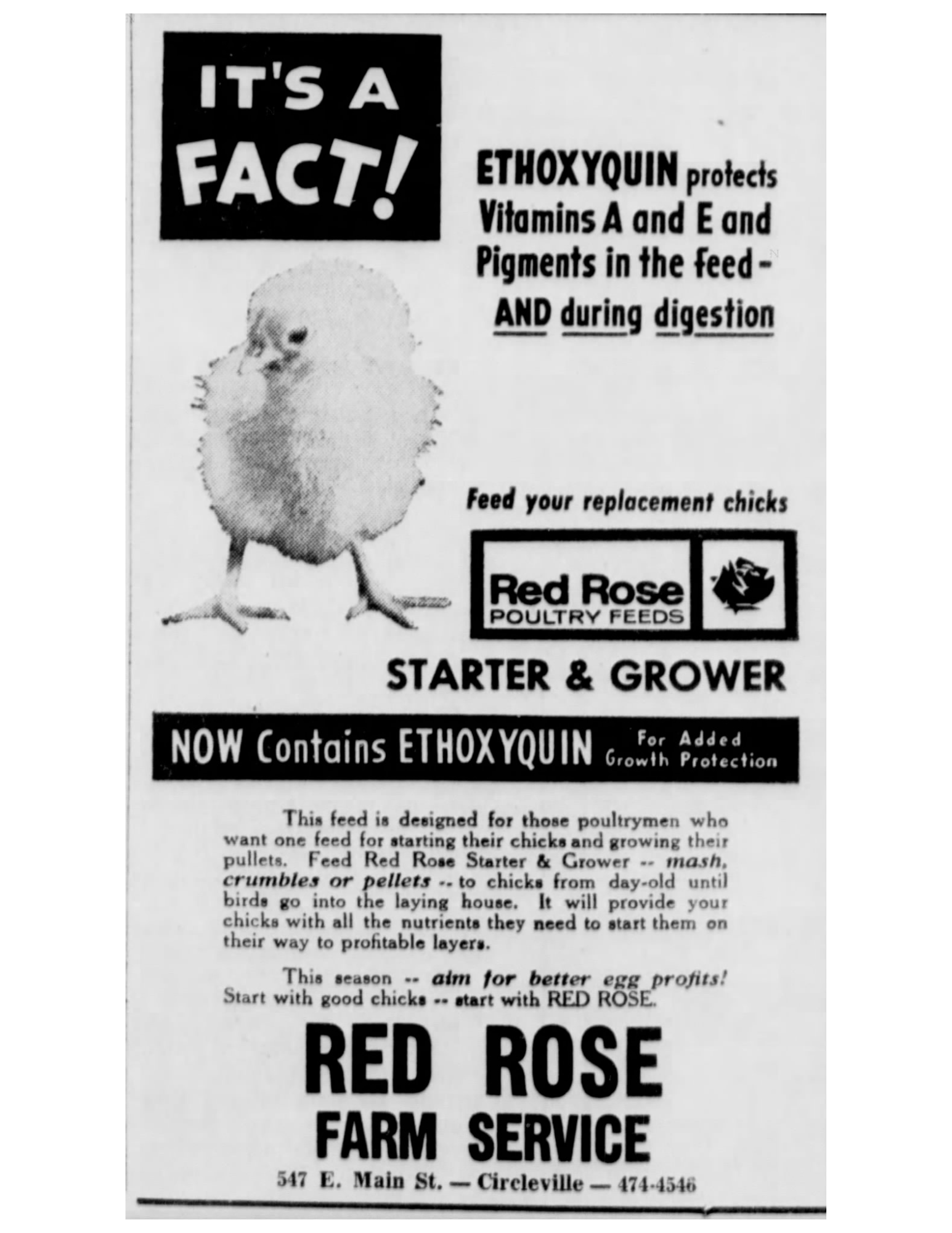
Soon, feed companies marketed ethoxyquin-treated fishmeal as not just safer but also more nutritious. “It’s a fact!” a 1969 Red Rose Poultry Feeds advertisement claimed, “ethoxyquin protects vitamins A and E and pigments in the feed.”12 A Hubbard Milling Company advertisement added that with their ethoxyquin-containing feed, “the right feed at the right time means more profit for you!”13
Most experts agreed that the chemical was highly effective. By the 1970s, press-reported fires dropped sharply—from a typical 16 ship fires a year, according to the Liverpool Underwriters’ Association, to five in 1967.14 A Florida newspaper wrote that ethoxyquin could “eliminate serious hazards of combustion” and make fishmeal “safe for transportation.”15 “Antioxidant treatment has made bulk handling an easy matter,” the director of the Canadian Department of Fisheries told an industry publication in 1966, arguing it should be required for fishmeal shipments as it “is the more effective antioxidant,” despite being more expensive.16 By 1976, the US Coast Guard imposed mandatory ethoxyquin treatment on fishmeal shipments, and three years later, the UN body that oversees maritime activity recommended fishmeal be treated with ethoxyquin “to prevent spontaneous combustion.”17
But there was a problem with ethoxyquin: It is carcinogenic.18
As early as 1969, a group of UN food and agriculture authorities released a paper noting that “toxic effects had been observed in laboratory animals fed high concentrations of ethoxyquin” and that “occurrence of dermatitis among fruit packers suggests that sensitization could be a problem among those who are handling ethoxyquin.”19 As its use in animal feeds grew, a 1987 study by British researchers found the chemical “caused severe damage” and had a potentially “carcinogenic effect” in rats.20 In 2015, the European Food Safety Authority said an impurity within ethoxyquin, known as p-phenetidine, was a possible mutagen, capable of causing mutations in genetic material.21 Two years later, the European Commission suspended authorization for its use in animal feed across the European Union.22
Ethoxyquin has also been banned in the UK and by members of the European Economic Area, including Norway, Iceland, and Liechtenstein.23 Australia, Japan, South Korea, and the US still permit its use in feed but limit the maximum permissible level.24 While some countries, such as Peru and Vietnam, have not banned the chemical, their fishmeal industries have responded to the requirements of their major export markets by taking steps to ensure that aquafeed destined for certain parts of the world does not contain ethoxyquin.25
While ethoxyquin is not banned in the US, it has been at the center of a half-dozen lawsuits in American courts, typically involving claims of false advertising. In 2019, the NGO Toxin Free USA sued the J.M. Smucker Company and Ainsworth Pet Nutrition in Washington, DC, alleging consumer protection violations for labeling pet food as “natural” and free of “artificial preservatives” despite containing ethoxyquin.26 In a similar case in 2021, two national nonprofits, GMO Free USA and Clean Label Project Foundation, sued Nestle Purina Petcare Company for marketing cat food as containing “no artificial…preservatives” when it also contained ethoxyquin. Both pet food cases were settled out of court.27 Also in 2021, a California resident brought a class-action suit against Champion Petfoods USA, alleging false marketing of its pet food as made with “wild-caught fish,” since ethoxyquin is only found in farmed fish.28 The court dismissed this claim.M
Other lawsuits have targeted seafood companies for marketing their products as “sustainable” even though they were found to contain ethoxyquin.M Specifically, these cases have highlighted the potential risks that the additive poses to the environment. In 2022, a New York resident brought a class-action lawsuit against Aldi, Inc., a German supermarket chain, alleging its Atlantic salmon products were falsely labeled as “sustainable” due to “environmentally destructive” practices.29 The complaint cited the EU’s ban on the chemical and a study linking ethoxyquin to mortality and deformations in fish and crustaceans, noting it “poses a risk for aquatic life.”30 The case was settled out of court. Also in 2022, a New York and a California resident jointly sued seafood company Gorton’s Inc. for labeling its frozen tilapia as “sustainably sourced” despite containing ethoxyquin.31 This lawsuit also cited the “risk for aquatic life” and the European Union’s ban, and was settled out of court.M
Roughly 80 percent of seafood consumed in the US is imported, with China being the biggest supplier.32 In 2024, the US imported 768 million pounds of seafood from China, more than from any other country, according to trade data by the National Oceanic and Atmospheric Administration.33 China is also among the biggest global users of ethoxyquin, as Asia is the largest market for feed antioxidants and China is the top regional consumer, according to a 2025 industry report.34 The chemical’s prevalence is a concern for Beijing as the government works to clean up contamination on fish farms and in the nearshore ocean along China’s eastern coast. In 2018, Chinese researchers studying water pollution found ethoxyquin to be one of the most abundant contaminants in a Yangtze River reservoir that supplies over half the drinking water in Shanghai.35M
Ethoxyquin is making its way into US-consumed seafood. A review of more than 350,000 weekly FDA inspection reports from 2018-2022 showed trace amounts of the chemical in three seafood types: shrimp, especially from Indonesia and India; salmon, most often from Chile; and tilapia, frequently from China.36M While the detected levels were always below the amount the FDA deems safe, critics claim this safe level is weak compared to the one in the EU, which bans any amount appearing in food.37 Though ethoxyquin is also used on fruits and vegetables to slow skin drying, FDA data indicates that seafood is over 10 times more likely to arrive in the US containing the chemical compared to other tested foods, including asparagus, cucumbers, and tomatoes.38
Since the EU ban, other antioxidants have been substituted for ethoxyquin, including synthetic chemicals like butylated hydroxyanisole (BHA) and natural additives such as rosemary extract and vitamin E compounds.39 “More and more destinations are not accepting ethoxyquin, starting with our local Peruvian market,” said James Frank, Managing Director of the Peruvian fishmeal company MSI Ceres, during a 2022 webinar. He added that 100 percent of Peru’s fishmeal exports to Europe, Canada, the US, and Australia are now ethoxyquin-free, a shift also seen among companies in the UK and Norway.40
BHA is the most popular alternative to ethoxyquin, favored for its lower costs and strong antioxidant properties over fully natural additives.41 But, in yet another unfortunate cycle of unintended consequences, this replacement has raised serious concerns. Like the chemical it aims to supplant, BHA has its own significant health risks, according to researchers. The US National Toxicology Program identified BHA as “reasonably anticipated to be a human carcinogen” in 1991, and Japanese researchers found it caused malignant tumors in laboratory rats in 2008.42
For the time being, European regulators have deemed BHA safe enough to use. In 2018, a panel from the European Food Safety Authority concluded there was “no concern for consumer safety” when BHA is used as a feed additive below the EU’s established limit of 150 milligrams per kilogram of feed.43 The US is reassessing the matter; the Food and Drug Administration took a more cautious approach, announcing in 2025 that it would reassess the safety of the substance as a food additive.44